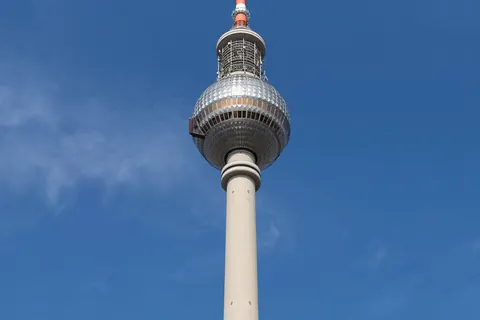
The Fernsehturm in central Berlin was constructed between 1965 and 1969 by the government of the German Democratic Republic as both a functional broadcasting facility and a symbol of communist power.
It remains a landmark today from its position next to Alexanderplatz in the city’s Marien Quarter, part of the district of Mitte, visible across most suburban districts of Berlin. With a height of 368 metres it is the tallest structure in Germany, and the third-tallest structure in the European Union. When built it was the fourth-tallest freestanding structure in the world after the Empire State Building and the John Hancock Center.
Of the four tallest structures in the European Union, the Fernsehturm is two metres shorter than the Torreta de Guardamar, 0.5 m shorter than the Riga Radio and TV Tower, and 8 m taller than the Trbovlje Power Station. The structure is also more than 220 m higher than the old Berlin Radio Tower in the western part of the city, which was built in the 1920s.
In addition to its main function as the location of several radio and television transmitters, the building – internally known as "Fernmeldeturm 32" – serves as a viewing tower with an observation deck including a bar at a height of 203 metres, as well as a rotating restaurant. Also, the Berlin TV Tower can be booked as a venue for events. The distinctive city landmark has undergone a radical, symbolic transformation: After German reunification, it changed from a politically charged, national symbol of the GDR into a citywide symbol of a reunited Berlin. Due to its universal and timeless design, it has increasingly been used as a trademark and is identified worldwide with Berlin and Germany. In 1979, the Berlin TV Tower received official monument status by the East German government, a status which was perpetuated after the German reunification.
The tower has become one of the most prominent symbols of the country and is often in the establishing shot of films set in Berlin, alongside monuments such as the Brandenburg Gate, the Berlin Victory Column and the Reichstag building. It is also one of the ten most popular attractions in Germany with more than one million visitors every year.
Sources
- Wikipédia (fr) : Fernsehturm de Berlin
- Wikipedia (en): Fernsehturm Berlin
- Wikidata: Q151356
- Official website
Text: introduction of the Wikipedia article Fernsehturm Berlin, under the CC BY-SA 4.0 licence (authors: article history). Facts: Wikidata (CC0). Coordinates: Wikidata, map background © OpenStreetMap contributors.